Agentic AI as an Infrastructure Driver
What Autonomous Agents Demand from the Public Cloud
From Chatbot to Autonomous Agent
2026 marks a turning point for the public cloud market: AI systems are evolving from reactive chatbots into autonomous agents that independently plan tasks, call tools, and make decisions across multiple steps. According to IDC, more than 50% of enterprises will deploy AI agents to steer core business processes by 2027 – no longer as an experiment, but as a productive part of value creation.
At the same time, AI’s share of overall cloud spending is rising rapidly: analysts expect AI-related cloud spending to already account for nearly 20% of total cloud spend in 2026, up from around 8% just three years ago. A growing portion of this investment is no longer flowing into classic model inference, but into the infrastructure surrounding autonomous agents – that is, into orchestration, data connectivity, and governance.
This shift is more than a new feature at the application layer. It fundamentally changes the demands placed on the underlying cloud infrastructure – and that’s exactly where this post picks up. While public discussion tends to focus on model capabilities and agent frameworks, in practice it’s often the underlying infrastructure that determines whether an agentic AI project makes the leap from pilot phase to production.
What Makes Agentic AI Infrastructurally Different
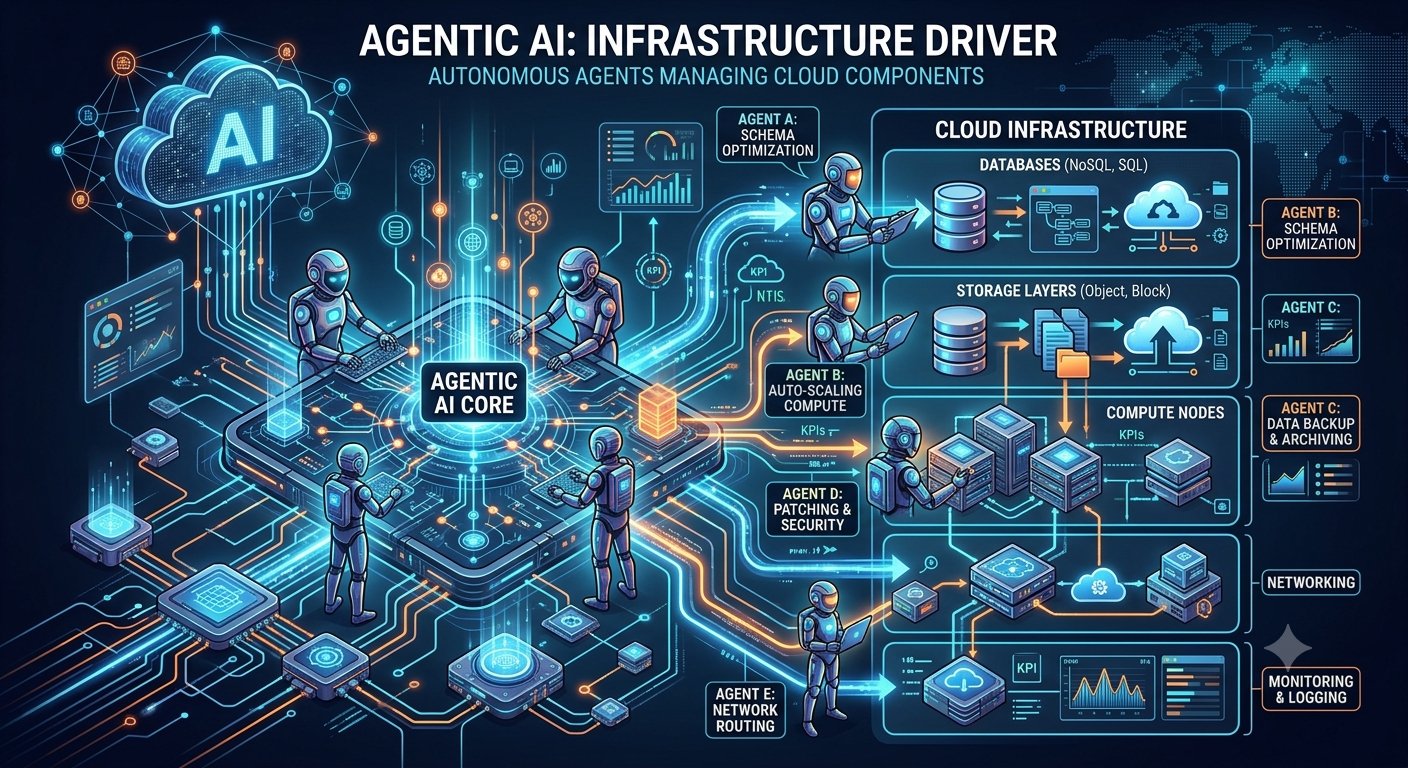
Classic generative AI applications follow a simple pattern: request in, response out. Agentic AI systems break with this pattern. An agent plans a task, calls multiple tools and data sources in sequence, evaluates intermediate results, and makes further decisions on that basis – often fully autonomously and over minutes or hours, sometimes as an interplay between several specialized agents.
For infrastructure, this brings several shifts at once: load profiles change from short, bursty requests to continuous, long-running inference pipelines. Classic auto-scaling, designed for short-term load spikes, falls short here – what’s needed instead are architectures that can efficiently sustain persistently high but variable baseline load.
At the same time, the number of systems that access data and services independently is increasing. Agents increasingly act like independent, non-human identities within the corporate network — with their own permissions, their own access patterns, and their own risk profile. This combination of new load profiles and new identity types is at the core of what makes agentic AI infrastructurally its own category.
Three Critical Infrastructure Requirements
1. Identity & Governance for Non-Human Identities
Agents, bots, and machine accounts are becoming the new primary risk surface. According to recent surveys among security leaders, AI agents create faster and harder-to-detect attack surfaces than classic automation – and most organizations still lack a mature governance model for these non-human identities. Without a granular permission model, hard-to-trace access patterns become likely; governance thus becomes a prerequisite for the productive use of agentic AI.
2. Real-Time Data Pipelines & Vector Databases
Agents need continuous, low-latency access to current enterprise data – frequently via vector databases for retrieval-augmented generation, as well as feature stores for structured data. Storage performance and data consistency thus become the limiting factor for the quality and reliability of agent decisions: an agent can only plan as well as the data it accesses is current and accessible.
3. Scalable Model-Serving Infrastructure
Inference routers, gateways, and autoscaling layers must handle heavily fluctuating, but generally rising, load. Because agents frequently trigger multiple model calls per task, latencies add up along the entire chain. Reproducible infrastructure, automated via infrastructure-as-code, thus becomes essential to operating agentic AI workloads reliably and cost-effectively.
Why This Is an FSxN Topic
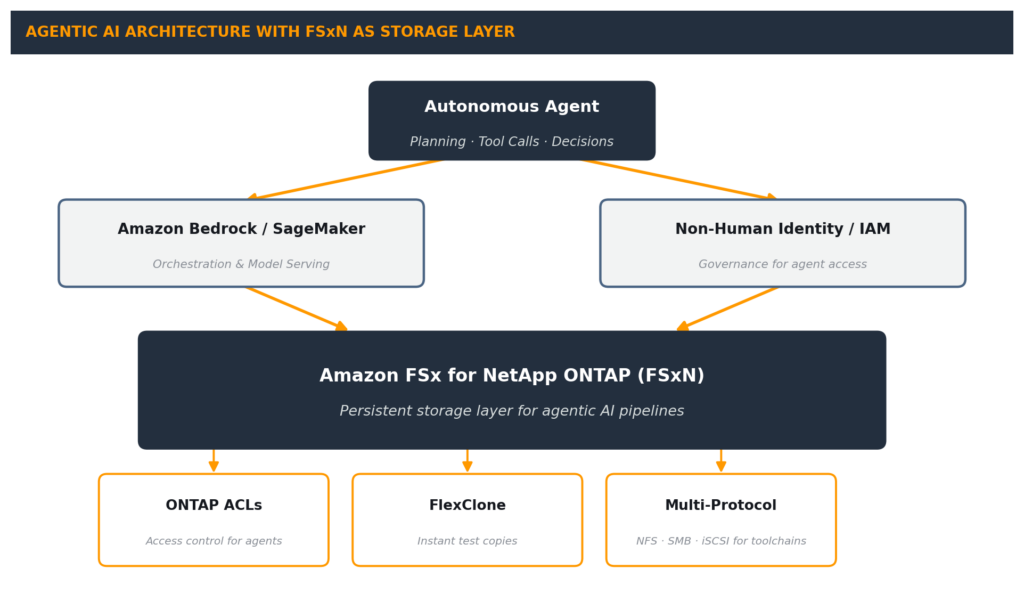
Amazon FSx for NetApp ONTAP (FSxN) addresses central challenges of agentic AI architectures at exactly these three points. In a typical scenario, an agent – via Amazon Bedrock or SageMaker, for example – orchestrates multiple knowledge and data sources to complete a task independently. FSxN takes on the role of the persistent, business-critical storage layer behind this orchestration, while the actual agent logic runs within the AI services.
Specifically, the value shows up in three places. First, native ONTAP ACLs enable granular, file-based access control for non-human identities: an agent receives exactly the permissions it needs for its specific task – no more – and access is traceably logged. This directly addresses the governance gap that often arises with purely application-side permission models.
Second, FlexClone allows isolated, space-efficient copies of production data to be created in seconds for agent testing and validation, without touching the live environment or consuming significant additional storage. Because agents act autonomously, the ability to test their behavior beforehand against realistic but isolated data copies is an essential building block for safe production operation.
Third, FSxN’s multi-protocol capability (NFS, SMB, iSCSI) ensures that heterogeneous agent toolchains – from Python-based frameworks to containerized microservices on EKS via Trident CSI – access the same consistent data foundation without having to duplicate or synchronize data. For RAG-based agentic pipelines, this means FSxN delivers not only the storage performance needed for vector databases and knowledge bases, but also the governance and snapshot mechanisms that meet enterprise requirements for traceability and testability.
In short: FSxN evolves from classic enterprise storage into an active building block of agentic AI governance – wherever performance, access control, and testability need to come together.
Conclusion: Infrastructure Is Necessary, But Not Sufficient
Gartner expects around 40% of agentic AI projects to fail by 2027 – not because the technology falls short, but because organizations automate existing, immature processes instead of rethinking them. A resilient infrastructure with clear governance for non-human identities, a high-performance data layer, and scalable model serving is therefore a prerequisite – but only a prerequisite. The real success factor lies in designing business processes so that agents can be meaningfully embedded, rather than automating existing workflows unchanged.
For organizations investing in agentic AI now, it’s worth paying at least as much attention to the storage and governance layer as to the agent framework itself. Those who account for this layer from the outset not only reduce the risk of failed projects but also lay the foundation to scale agentic AI use cases beyond isolated pilot projects.
FSxN offers a solid starting point here for building in performance, security, and testability from day one – as the link between the flexibility of autonomous agents and the control requirements of production enterprise environments. In an upcoming post, we’ll look at a concrete reference architecture that brings these building blocks together into a production-ready agentic AI pipeline with FSxN.
Comments are closed